Choosing the Right Visual Assets: A Guide to Butterfly and Leaf Silhouettes in Design Projects
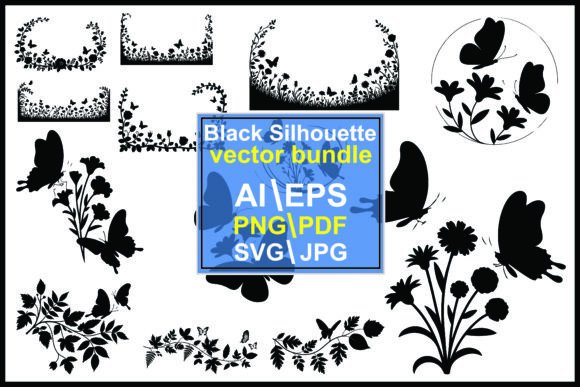
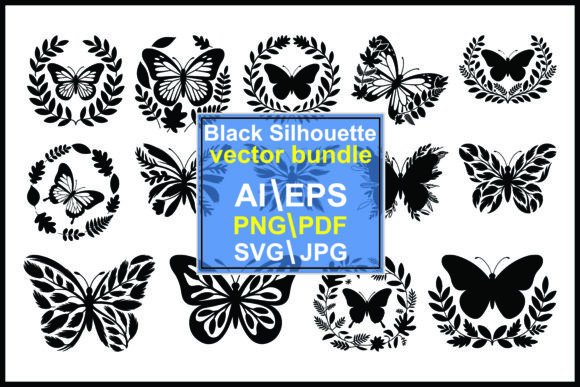
In the vast landscape of digital design resources, selecting the right visual elements can define the success of a project. For designers, crafters, and content creators aged 20 to 50 who are evaluating assets for branding, home decor, or personal art, butterfly and leaf silhouettes offer a distinct advantage. Unlike full-color illustrations or complex photographic textures, silhouettes rely on high-contrast shapes to convey form and movement. This specific style, often characterized by black forms against a white background or vice versa, provides a level of versatility that colored assets simply cannot match. When these organic shapes are arranged within circular frames, they create a structured yet natural aesthetic that bridges the gap between minimalist modernism and traditional botanical art.
Understanding the Distinct Appeal of Silhouette Art
The primary strength of using butterfly and leaf silhouettes lies in their adaptability. Because these designs strip away internal details like veins, shading, and color gradients, they function as universal symbols of nature. A silhouette of a butterfly wing or a piece of foliage can be scaled up for a large wall mural or scaled down for a business card without losing clarity. This is a critical factor when comparing silhouettes to raster-based photographs or detailed paintings, which often pixelate or lose definition when resized significantly.
Furthermore, the symmetrical arrangement often found in these collections adds a layer of decorative balance. When butterflies and leaves are positioned within circular frames, the design creates a focal point that draws the eye inward. This geometric containment contrasts beautifully with the organic curves of the wings and foliage, creating a visual tension that is pleasing to the viewer. For those researching design trends, this combination of geometric structure and natural flow is a hallmark of contemporary botanical themes, making it suitable for everything from wedding invitations to tech startup logos.
Comparing File Formats: Vector vs. Raster for Your Needs
When evaluating a resource bundle for butterfly and leaf silhouettes, understanding the file formats included is paramount. Most professional bundles, including comprehensive collections, offer a mix of vector and raster files. The distinction between these formats often dictates the suitability of the asset for your specific project.
- Vector Files (AI, EPS, SVG, PDF): These are the gold standard for scalability. If you intend to use the silhouettes for large-format printing, such as wallpaper, vinyl cutting, or signage, vector formats are essential. They allow you to resize the black and white butterfly and leaf silhouettes infinitely without any loss of quality. Additionally, vectors allow for easy editing of anchor points, meaning you can customize the shape of a wing or leaf if your design requires a unique variation.
- Raster Files (JPG, PNG): These are pixel-based images. While a high-resolution JPG is sufficient for web use or standard document printing, it lacks the flexibility of vectors. However, PNG files with transparent backgrounds are incredibly useful for quick drag-and-drop applications in software like Canva or Photoshop, where users may not have vector editing capabilities.
A robust bundle typically includes all these formats, often compressed into a single ZIP file. This approach ensures that regardless of your software preference—whether you are an Adobe Illustrator veteran or a casual user of free online tools—you have the appropriate file type. It is important to note that extracting these files requires standard utility software like WinZip or WinRAR, or the built-in extraction tools available on most modern operating systems. Once extracted, the variety of formats allows for a seamless workflow across different stages of a project.
Evaluating Use Cases: Where Silhouettes Excel
Determining whether butterfly and leaf silhouettes are the right choice depends heavily on the intended application. These assets shine in scenarios where clarity and reproduction cost are concerns. For example, in craft and collage projects, the high contrast of black silhouettes makes them ideal for die-cutting machines and stencil creation. The lack of intricate internal detail ensures that the cut lines are clean and the final product is durable.
In the realm of print and wallpaper, the minimalist nature of these designs allows them to serve as effective patterns. A repeating pattern of circular frames containing floral and fauna silhouettes can create a sophisticated backdrop that does not overwhelm a room's existing decor. This is a significant trade-off compared to busy, multi-colored wallpapers; while silhouettes offer less visual "noise," they provide a timeless elegance that is less likely to feel dated over time.
However, there are limitations. If a project requires a hyper-realistic representation of nature, perhaps for a scientific publication or a nature documentary graphic, silhouettes may be too abstract. In such cases, detailed illustrations or photography would be more appropriate. Similarly, if a brand identity relies heavily on a specific, vibrant color palette to evoke emotion, starting with a black-and-white silhouette requires an extra step of recoloring and styling, which might not be efficient for every timeline.
Decision Factors: Licensing and Versatility
One of the most critical aspects of choosing a design resource is the licensing agreement. Many creators look for assets that offer freedom of use. High-quality bundles often come with licenses that permit usage for any purpose, including commercial projects. This flexibility is a major advantage over subscription-based stock photo sites where licensing terms can be restrictive or require ongoing payments to maintain legal usage.
When comparing a dedicated silhouette bundle to piecing together individual elements from various free sources, the value of a cohesive collection becomes apparent. A curated set ensures that the line weights, stylistic approaches, and proportions of the butterflies and leaves are consistent. Mixing disparate sources often results in a disjointed final product where one leaf looks hand-drawn and another appears digitally perfect. A unified bundle eliminates this inconsistency, providing a professional finish to floral nature themes.
Practical Considerations for Implementation
For those ready to integrate these assets into their workflow, the process is generally straightforward but requires attention to detail. Upon downloading a ZIP file containing the full collection, the first step is extraction. Users should verify that they have the necessary software to handle compressed archives. Once the files are accessible, organizing them by format (e.g., separating SVGs from PNGs) can streamline the design process.
Designers should also consider the context of the background and texture. While silhouettes are traditionally black on white, their true power is revealed when placed on colored backgrounds or textured overlays. The solid fill of a silhouette allows it to stand out against complex patterns, whereas a detailed illustration might get lost. Experimenting with negative space—using the silhouette as a cut-out to reveal a background image—is another advanced technique that leverages the simplicity of the format.
Making the Final Choice
Ultimately, the decision to use butterfly and leaf silhouettes in circular frames comes down to the specific goals of your project. If you prioritize scalability, ease of customization, and a clean, modern aesthetic, these assets are an excellent investment. They bridge the gap between decorative art and functional design, offering a solution that works equally well for digital screens and physical prints.
Conversely, if your project demands photorealism or specific color grading out of the box, you may need to supplement silhouettes with other types of media. However, for a wide range of applications—from collage and craft to professional branding and interior decor—the versatility of a comprehensive silhouette bundle makes it a staple resource. By understanding the strengths of vector formats, the importance of consistent styling, and the flexibility of high-contrast design, you can make an informed choice that elevates your creative output.