Strategic Minimalism: Leveraging Continuous Line Design of a Bucket for Brand Clarity
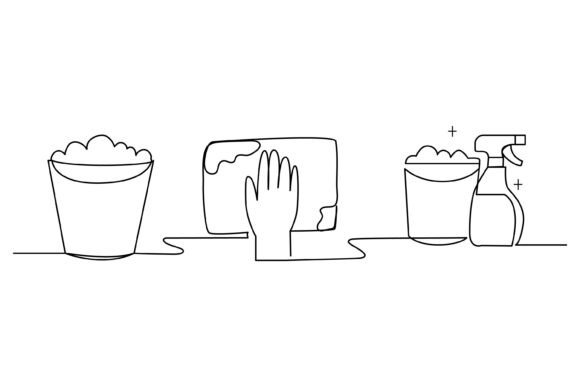
In an era where visual noise often drowns out meaningful communication, the decision to adopt a Continuous Line Design of a Bucket represents more than just an aesthetic choice; it is a strategic maneuver toward clarity. This specific style of illustration, characterized by a single, unbroken stroke that defines the form without lifting the pen, forces a discipline of simplicity that resonates deeply with modern audiences. When applied to functional imagery like a cleaning bucket, particularly one filled with foam, this design approach strips away unnecessary detail to reveal the essential function and character of the object. For entrepreneurs, marketers, and creators, understanding how to deploy this asset effectively can significantly impact branding consistency, user experience, and operational efficiency.
The core value of a continuous line drawing lies in its ability to convey complex ideas through minimal means. A bucket drawn in this style is not merely a picture of a container; it is a symbol of utility, cleanliness, and preparation. When you integrate a Continuous Line Design of a Bucket filled with foam into your visual identity, you are signaling a commitment to streamlined processes and effective solutions. The foam adds a layer of narrative—it suggests action, abundance, and the active process of cleaning—while the single line ensures the message remains uncluttered. This balance between detail (the foam) and restraint (the single line) is where the true strategic power resides.
Aligning Visual Assets with Strategic Goals
Before downloading or commissioning any graphic asset, including an EPS, SVG, or JPG file of a bucket, you must align the visual with your broader business objectives. The Continuous Line Design of a Bucket is versatile, but its effectiveness depends entirely on context. If your goal is to establish a brand identity that feels approachable yet professional, this style offers a unique advantage. It avoids the sterility of corporate clip art while maintaining the sophistication of custom illustration.
Consider the planning phase of a marketing campaign for a cleaning service or a home organization product. Using a continuous line motif across your website, social media, and printed materials creates a cohesive visual language. This consistency aids in brand recall. When a customer sees that singular line forming a bucket on your invoice, your website header, and your service vehicle, they subconsciously register a unified entity. This is not accidental; it is the result of intentional visual planning. The continuous line acts as a thread connecting disparate touchpoints, reinforcing the idea that your business operates with seamless efficiency.
Furthermore, this design style supports cognitive ease. In a world of information overload, the human brain prefers images that are easy to parse. A single line decorative element drawn on white provides immediate recognition without demanding significant mental energy. This allows your audience to focus on your value proposition rather than deciphering a complex graphic. For educators and content creators, this means your instructional materials become more accessible. For small business owners, it means your advertising cuts through the clutter faster.
Practical Applications Across Industries
The utility of a Continuous Line Design of a Bucket extends far beyond the cleaning industry. While obviously pertinent to janitorial services, carpet cleaners, and household product manufacturers, its application is surprisingly broad for any sector valuing transparency and simplicity.
- Service-Based Businesses: Use the icon to represent "tools of the trade" or "preparation" in service diagrams. The bucket filled with foam can specifically denote the "execution" or "active service" phase of a client journey.
- Digital Products and Apps: Incorporate the SVG version into user interfaces as a loading state or a success indicator for completed tasks, leveraging the "cleaning up" metaphor for organizing data or clearing caches.
- Educational Content: Bloggers and publishers can use these illustrations to break up text-heavy articles, providing visual anchors that maintain reader engagement without distracting from the core message.
- Packaging Design: The minimalist nature of the line art works exceptionally well on packaging where space is premium. It conveys the product's purpose instantly while leaving room for regulatory text and branding.
When selecting the file format, your decision should be driven by the intended medium. For web use, the SVG (Scalable Vector Graphics) format is indispensable. It ensures the Continuous Line Design of a Bucket remains crisp on any screen resolution, from mobile phones to 4K monitors, and allows for CSS styling changes such as color shifts on hover. For print materials like business cards, brochures, or large-scale signage, the EPS file is the industry standard, offering infinite scalability without pixelation. The JPG serves well for quick previews, social media posts, or contexts where vector editing is not required. Having access to all three formats ensures you are prepared for any scenario, preventing last-minute scrambling for higher-resolution assets.
Risks of Unintentional Implementation
While the benefits are substantial, relying on a Continuous Line Design of a Bucket without a clear strategy carries risks. The primary danger is trivialization. If used indiscriminately, a simple line drawing can make a serious business appear amateurish or lacking in substance. This style thrives on intentionality. If your brand positioning relies on luxury, heaviness, or intricate detail, a minimalist line drawing might undermine that perception. You must evaluate whether the "lightness" of the line matches the "weight" of your service offering.
Another risk is inconsistency in application. Because the design is so simple, it is tempting to overuse it or alter it inconsistently across different platforms. Changing the line weight, color, or orientation without a defined style guide can fracture your brand identity. The strength of the continuous line is its uniformity; breaking that rule dilutes its impact. Additionally, ensure that the metaphor holds up. If you are selling high-tech software solutions, a bucket of foam might confuse the audience unless the connection between "cleaning up data" and the visual is explicitly made in your copy.
Decision-Making Framework for Adoption
To ensure you are using the Continuous Line Design of a Bucket strategically, apply the following decision-making framework before integration:
- Define the Objective: Are you trying to simplify a complex message, add a touch of humanity to a digital interface, or create a recognizable brand mark? If the answer is vague, reconsider the asset.
- Audience Alignment: Does your target demographic respond well to minimalism? Professionals and decision-makers often appreciate clean, efficient visuals that respect their time, whereas some consumer markets might prefer more vibrant, detailed imagery.
- Contextual Fit: How does the bucket filled with foam relate to your specific narrative? Ensure the "foam" element adds value—signifying richness, action, or results—rather than just being decorative noise.
- Technical Readiness: Do you have the capability to utilize vector files (EPS/SVG) effectively in your current workflow? If your team only works with raster images, the benefits of scalability may be lost.
By answering these questions, you move from random decoration to strategic deployment. The goal is not just to have a pretty image, but to have an image that works for your business goals.
Long-Term Value and Adaptability
The longevity of a visual asset is a key consideration for long-term planning. Trends in design come and go, but the principle of simplicity is enduring. A Continuous Line Design of a Bucket is less likely to feel dated in five years compared to a highly stylized, trendy illustration. This timeless quality protects your investment. As your business grows and evolves, the core visual can remain constant while surrounding elements change. You can adapt the color, the background, or the accompanying text without needing to redraw the core icon.
Moreover, this design approach fosters creativity within constraints. By limiting yourself to a single line, you encourage your team to think differently about how to communicate. It challenges marketers to write clearer copy and designers to layout pages with more breathing room. This ripple effect can improve overall communication quality within your organization. When the visual language is disciplined, the verbal language often follows suit.
Ultimately, the choice to utilize a single line decorative element drawn on white depicting a bucket and foam is a choice for clarity. In a marketplace saturated with complexity, the brand that can communicate its value simply and elegantly often wins. Whether you are a freelancer building a portfolio, a startup launching a product, or an established enterprise refreshing your image, the strategic application of continuous line design offers a pathway to distinctiveness. It reminds us that sometimes, the most powerful statement is made not by adding more, but by drawing a single, confident line that connects everything together.
As you move forward with your planning, remember that the files you acquire—be it EPS, SVG, or JPG—are tools. Their value is unlocked only through thoughtful application. Treat the Continuous Line Design of a Bucket not as a mere clip-art addition, but as a foundational element of a broader strategy aimed at better decisions, clearer communication, and superior long-term results.