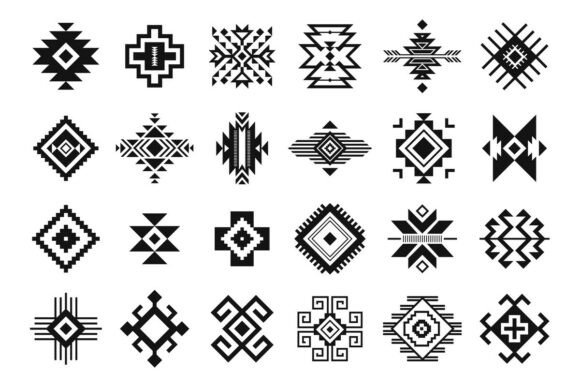
Decoding Tribal Elements: Monochrome Geometric Patterns for Modern Design
The visual language of Tribal Elements. Monochrome Geometric represents a fascinating intersection where ancient cultural heritage meets contemporary minimalist aesthetics. For designers, textile artists, and brand strategists aged 20 to 50, understanding this specific niche is crucial when evaluating resources for projects that require depth without visual clutter. This style is not merely about stripping color from traditional motifs; it is a deliberate design choice that emphasizes form, rhythm, and the mathematical precision inherent in indigenous art forms such as Navajo weaving and Aztec stonework.
When you encounter a vector set described as Monochrome geometric American Indian patterns or ethnic ornament for textile decorative ornament, you are looking at a curated collection of symbols that have been distilled to their essential lines and shapes. These elements serve as black cultural national symbols and art decorations that carry historical weight while offering immense versatility in modern application. The decision to utilize these monochromatic assets over their full-color counterparts or other graphic styles involves several tradeoffs regarding mood, scalability, and cultural resonance.
The Distinctive Nature of Monochrome Tribal Geometry
What sets Tribal Elements. Monochrome Geometric apart from general pattern libraries is the rigorous focus on contrast and structure. In full-color tribal designs, the eye is often drawn to the interplay of hues—terracotta reds, turquoise blues, and ochre yellows common in Southwestern palettes. However, by removing color, the designer forces the viewer to engage with the geometry itself. The zigzags representing lightning in Navajo traditions or the stepped frets symbolizing mountains in Aztec architecture become the primary narrative devices.
This approach creates a distinct aesthetic profile. It feels more architectural and less folkloric. When used as an ethnic ornament for textile decorative ornament vector set, the monochrome limitation ensures that the pattern can be scaled infinitely without losing definition. A complex, multi-colored motif might blur when reduced to a small scale on a mobile interface or a clothing tag, but a high-contrast black-and-white geometric line remains crisp. This makes the style particularly valuable for branding applications where clarity is paramount.
Furthermore, the term "monochrome" in this context does not always strictly mean black and white. It can refer to a single hue applied with varying opacity or weight, though the classic interpretation relies on the starkness of ink on paper. This simplicity allows the art decoration to function as a texture rather than just an image, adding tactile quality to digital screens or fabric surfaces without overwhelming the primary content.
Comparing Monochrome Tribal Styles to Alternatives
To make an informed decision about incorporating these elements, one must compare them against similar categories. How does Tribal Elements. Monochrome Geometric stack up against full-color ethnic patterns, abstract organic shapes, or modern corporate geometrics?
- Versus Full-Color Ethnic Patterns: Full-color versions of Navajo or Aztec designs evoke warmth, tradition, and specific regional identities. They are excellent for tourism marketing, cultural festivals, or products aiming for a rustic, handcrafted feel. However, they can date quickly if the color palette trends shift. Monochrome options offer timelessness. They strip away the seasonal trendiness of color, leaving a classic foundation that adapts to any brand palette.
- Versus Abstract Organic Shapes: Modern design often favors fluid, blob-like organic shapes that feel soft and approachable. Tribal geometric elements, by contrast, are rigid, angular, and structured. If your project requires a sense of stability, strength, or heritage, the sharp angles of black cultural national symbols are superior. If the goal is softness or playfulness, organic shapes may be the better fit.
- Versus Corporate Geometrics: Standard corporate geometry often relies on perfect circles, squares, and generic grids. While clean, these can feel sterile. Tribal geometry introduces irregularity within order. The "hand-drawn" imperfection often found in vector recreations of indigenous weavings adds a human touch that pure mathematical geometry lacks, bridging the gap between professionalism and soulfulness.
The choice ultimately depends on the emotional response you wish to elicit. Tribal Elements. Monochrome Geometric commands attention through authority and history, whereas softer alternatives might invite comfort. For a luxury streetwear brand or a high-end architectural firm, the boldness of monochrome tribal lines often communicates a stronger identity than generic patterns.
Evaluating Use Cases and Practical Applications
Understanding where these elements fit best is key to leveraging their potential. The utility of a vector set containing Monochrome geometric American Indian patterns extends far beyond simple decoration. Because vectors are resolution-independent, they are ideal for large-format printing, such as wall murals or building wraps, where pixelation would ruin a raster image.
In the fashion industry, these patterns are frequently used for textile printing. The high contrast of black and white works exceptionally well on both light and dark fabrics, allowing for versatile production runs. A designer can print white ink on a black shirt or black ink on a white shirt using the same asset file, doubling the product variations without needing new designs. This efficiency is a significant practical advantage over multi-color prints, which often require separate screens or complex digital printing setups for each color variation.
For digital products, such as website backgrounds or app interfaces, these elements serve as subtle textural layers. When used at low opacity, a repeating Aztec step pattern can add depth to a landing page without distracting from the call-to-action buttons. This is a nuanced application where the art decoration supports the user experience rather than competing with it.
Additionally, packaging design benefits greatly from this style. Luxury goods often utilize monochrome schemes to convey sophistication. Incorporating ethnic ornament in a single color can suggest a connection to artisanal roots or sustainable sourcing, aligning the product with values of authenticity and heritage.
Limitations and Cultural Considerations
While the aesthetic appeal of Tribal Elements. Monochrome Geometric is undeniable, responsible usage requires acknowledging the source material. These are not random shapes; they are black cultural national symbols with deep meanings for Native American communities, including the Navajo, Hopi, and descendants of the Aztec empire. Using them purely as "cool graphics" without understanding their context can lead to cultural appropriation.
When evaluating resources, look for vector sets that provide context or are created by indigenous artists. There is a distinction between appreciating the geometric beauty of a pattern and commodifying sacred symbols. Some motifs are reserved for specific ceremonies or statuses within a tribe and should not be used in commercial contexts. A prudent designer will research the specific meaning of the geometric forms they intend to use. For instance, a pattern representing rain might be appropriate for a water conservation campaign but inappropriate for a unrelated consumer good.
Another limitation is the potential for visual harshness. Because monochrome geometric tribal designs rely on high contrast and sharp angles, they can appear aggressive if overused. In interior design, covering every wall with a bold Aztec repeat might make a space feel claustrophobic rather than inviting. Balance is essential. These elements work best as accents—on a throw pillow, a feature wall, or a border—rather than as an all-encompassing environment.
Making the Right Choice for Your Project
So, when is Tribal Elements. Monochrome Geometric the right choice? It is the optimal solution when you need a design that conveys strength, heritage, and timeless elegance. It fits projects that require high scalability, such as logos that must look good on a business card and a billboard. It is also the go-to for brands wanting to signal authenticity and a connection to craftsmanship without relying on clichéd rustic imagery.
Conversely, you might need an alternative if your target audience responds better to softness and fluidity, or if the project demands a vibrant, energetic mood that only a full spectrum of color can provide. If the budget allows for custom illustration, commissioning a specific cultural expert to create a unique pattern might yield better results than purchasing a generic stock vector set.
Ultimately, the value of Monochrome geometric American Indian patterns lies in their ability to tell a story through structure. They remind us that before color was added to human expression, there was line, shape, and rhythm. By choosing these elements, you are tapping into a visual lineage that predates modern design trends, offering your audience a sense of groundedness in an increasingly chaotic visual world. Whether for textile innovation, digital branding, or artistic exploration, these geometric forms remain a powerful tool in the creative arsenal, provided they are used with respect and strategic intent.